S2 Episode 5 — Good Debt, Bad Debt
Duration: 15:05 minutes
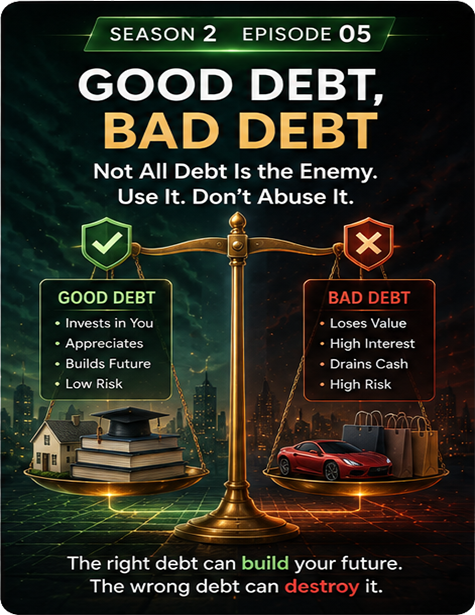
Not all debt is the enemy. The one question that separates debt that builds you from debt that drains you — mortgages, student loans, cars, and the order that decides everything.
Episode Overview
Duration: 15:05 minutes
Last episode was about the debt that quietly takes over. This one is the other half of the picture. Debt itself is not the enemy — some debt, used correctly, at the right time, for the right thing, is one of the most powerful financial tools available to you. The problem is that the line between the two is not obvious, and most people are asking the wrong question entirely. This episode gives you the one question that settles it, applies it to mortgages, student loans and the messy grey zone in between, and then sets out the order that decides whether even good debt actually works.
What You’ll Learn
- The single question that separates productive debt from unproductive debt
- Why a mortgage does something rent never does — and where that principle can still break
- Student loans: the three things that have to line up before the debt makes sense
- The grey zone — cars, laptops, tools of a trade — and how to judge it honestly
- The four-step order: what to clear, what to build, and when good debt earns its place
Key Takeaways
Ask what it produces, not what it costs per month
Can I afford the payment? Is the rate okay? Both are the wrong questions. The only one that matters is whether the debt produces more value than it costs. Ask it honestly before you sign anything, and every debt decision you ever make becomes clearer.
The grey zone is where honesty matters most
A car that gets you to a job you would otherwise lose can be justified. The same car upgraded beyond what the job requires cannot. Can I justify this? and does this produce more than it costs? are different questions — and the gap between them is where most debt mistakes live.
Order matters as much as category
Clear unproductive debt, build the emergency fund, start the investment engine, then consider productive debt. A mortgage taken before the foundation is solid does not stop being good debt in theory — it just becomes unmanageable in practise.
Episode Summary (click to expand)
An overview of what’s covered in this episode.
Last episode we looked at the enemy in your wallet — credit cards, instalment plans, personal loans for things that lose value the moment you buy them. The numbers were not pretty. But I want to make something clear today. Debt is not the enemy. Some debt, used correctly, at the right time, for the right thing, is a powerful financial tool available to you. The difference between the two is not always obvious — but there is a framework for telling them apart.
The Only Question That Matters
Ray Dalio, founder of Bridgewater Associates, has spent decades studying debt — how it works, how it builds wealth and how it destroys it. His way of separating good debt from bad comes down to one question: does this debt produce more value than it costs? Most people ask something else entirely. Can I afford the monthly payments? Is the interest rate okay? Those are the wrong questions. If the debt produces more than it costs, it can work in your favour. If it does not, it is working against you. You do not need to invoke it by name every time — you just need to ask it honestly before you sign anything.
Mortgages: Borrowing to Own Something Real
For most people at this life stage, a mortgage will be the largest financial commitment they ever make. At its core it is borrowing to acquire an asset — something real, something that in most markets over time holds or increases in value. Every payment builds equity. Compare that to rent. Rent is not wasted money; it buys flexibility. But rent does not build equity — every payment leaves and nothing returns. A mortgage does two things at once: it gives you a place to live, same as rent, and it builds ownership, which rent never does.
That is why, in principle, a mortgage is productive debt. But how much you borrow, what deposit you put down, the rate you fix and the market you buy in all determine whether the principle holds in practise. Get any of them badly wrong and productive debt becomes a burden very quickly.
Student Loans: Three Things Have to Line Up
The conventional wisdom is that education is an investment in yourself, therefore student debt is good debt. I want to challenge that, because it is not that simple. Whether a student loan is productive depends on three things working together, and if any one of them is badly out of proportion the debt fails, whatever the diploma says.
First, the salary uplift — does the degree lead to meaningfully higher income than you would have earned without it? For some fields the answer is clearly yes; for others the honest answer is less clear. That does not mean those degrees have no value. It means being honest about the financial return, separately from the personal and intellectual value. Second, the size of the debt — a useful rule of thumb is that total student debt should not exceed your expected first-year salary after graduation. Borrow more and the repayment timeline stretches while interest compounds against you. Third, the interest rate, which varies dramatically by country and loan type. In the US, private student loans can carry rates of 8 to 18%. In much of Europe, where universities cost far less and rates are lower or subsidised, the same analysis produces a very different answer. A few thousand euros borrowed in Portugal or Germany for a degree that adds significantly to earning power is clearly productive. Hundreds of thousands of dollars borrowed for a field with limited prospects and modest starting salaries can fail the test badly, regardless of how the loan is labelled.
The Grey Zone: Cars, Laptops and Honest Answers
Not all debt falls cleanly into a category, and pretending it does would be dishonest. A car is the most common example. In most cases borrowing to buy one is unproductive — it depreciates the moment you drive it away, generates no income, and by the time the loan is paid off you have paid more than the car was worth while the car is worth considerably less. But what if you need it to get to work? Then the car is enabling your income even if it is not directly generating it, and the maths changes. The question becomes whether having it allows you to earn more than the loan costs. If yes, it can be justified — but reluctantly and with discipline. Not the car you want. The cheapest reliable option that gets you where you need to go. The moment you upgrade beyond what the job requires, you have crossed back into unproductive territory.
The same applies to anything in this zone. A laptop for a freelance business, tools of a trade, equipment that enables income — if the thing you are borrowing for directly enables income greater than the cost of borrowing it, it passes. If it is a better version of something you already have, or something you want rather than need, it does not. And here is the honest truth about grey zone decisions: most people already know which side they are on. The question is not can I justify this? People can justify almost anything. The question is does this produce more than it costs?
The Order That Makes It Work
Even good debt at the wrong time can damage you. A mortgage taken before your emergency fund is solid, before your high-interest debt is cleared, before your income is stable enough to absorb a shock, does not stop being good debt in theory — it just becomes unmanageable in practise. One bad month and the repayment that felt manageable becomes the thing that keeps you awake at night. The order for this life stage is clear. First, clear the unproductive debt, because it compounds against you every month you carry it. Second, build and protect the emergency fund — the buffer that stops a bad month becoming a crisis and forces you straight back into the debt you just cleared. Third, build the investment engine: regular contributions, compounding in the background, and the earlier it starts the more time it has to work. Fourth, when the numbers genuinely work and the foundation underneath is solid, consider productive debt.
This sequence is a principle, not a rigid rule book. Some of you already have a mortgage. Some of you are already repaying student loans. You cannot go back and redo the order from scratch — but you can understand where you are and move in the right direction from here. If unproductive debt sits alongside a mortgage, the unproductive debt is still the priority. If there is no emergency fund and a mortgage, building the buffer is still urgent. The sequence is not about starting over. It is about knowing what to prioritise next.
Debt is a tool, and what matters is whether you are using it or it is using you. Unproductive debt takes money from your future and delivers nothing in return except the thing you wanted right now, and the interest compounds just as reliably as your investments do — only in the wrong direction. Productive debt, used correctly and at the right time, can accelerate everything. But smart requires honesty: about the numbers, about the timing, and about whether the thing you are borrowing for actually passes the test. Next episode we build the engine — what a portfolio looks like at this life stage, what to actually invest in, and how to start from zero. Mortgages get a dedicated bonus episode later in the series: the deposit, the rates, fixed versus variable, rent versus buy, all of it.