S2 Episode 4 — The Enemy in Your Wallet
Duration: 15:48 minutes
Credit cards, buy now pay later, personal loans. What they actually cost in real numbers — and the five rules for using them without letting them use you.
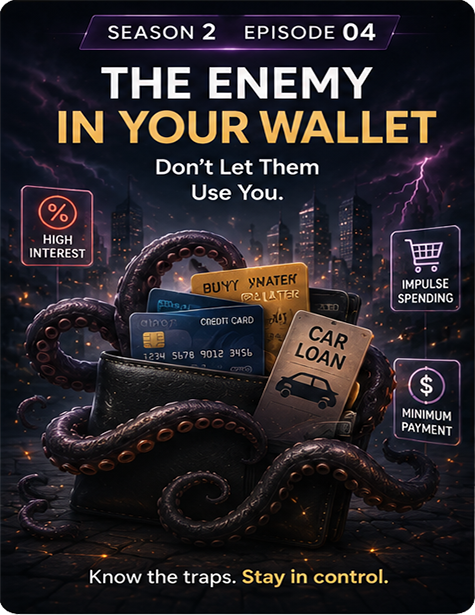
Episode Overview
Duration: 15:48 minutes
Credit cards, buy now pay later, and personal loans do not feel dangerous when you use them. That is exactly the point — they are designed to feel easy. This episode breaks down what these tools actually cost in real numbers, the five rules for using them correctly, and what to do if you are already carrying a balance that barely moves. Because some people listening are not trying to avoid the trap. They are already in it. This episode covers both.
What You’ll Learn
- What a $2,000 credit card balance on minimum payments actually costs — in time and in money
- How buy now pay later and personal loans work — and where the real cost hides
- The five rules for using credit without letting it use you
- Why willpower alone cannot beat minimum payment maths — and what actually can
- Debt consolidation, balance transfers, lender negotiation, and when more radical options are the right call
Key Takeaways
Minimum payments are not progress
A $2,000 balance at 20% interest on minimum payments takes nine and a half years to clear and costs nearly $1,900 in interest alone. The minimum payment is not designed to get you out. It is designed to keep you paying. That is the business model.
Calculate the total cost, not the monthly number
Before any personal loan or instalment plan, multiply the monthly payment by the number of months. Compare it to the actual price. The difference is what the debt costs you. If that number shocks you, it should — and it should change your decision.
If you are already stuck, try harder is not the answer
When most of your payment goes to interest, willpower cannot win fast enough. A debt consolidation loan, balance transfer, or direct conversation with your lender can change the maths entirely — and break a cycle that sacrifice alone cannot.
Episode Summary (click to expand)
An overview of what’s covered in this episode.
In the last three episodes we built something: you know your salary, you have a buffer, and you are starting to think like someone building a future instead of just surviving the month. Today we talk about the thing that can undo all of it — quietly, slowly, while feeling completely harmless the entire time.
The Real Cost of Minimum Payments
Credit cards, buy now pay later, and personal loans do not arrive looking dangerous. They arrive looking like solutions. The danger is not using them — it is not understanding what you are actually agreeing to. Take $2,000 on a credit card at 20% annual interest, the realistic average in many countries. Pay only the minimum each month and it takes nine and a half years to clear. Total cost: nearly $3,900. Almost $1,900 in interest alone — close to the original amount, paid again, just in interest. The minimum payment is not designed to help you pay it off. It is designed to keep you paying. That is the business model.
Buy Now Pay Later and Personal Loans
Instalment plans — pay in three, pay in four — feel safe because many advertise zero interest. Used correctly and paid on time, some genuinely cost nothing extra. But miss a payment and interest kicks in, often at credit card rates. And because these purchases feel smaller and more frequent, it is easy to lose track of how many are running at once. Three here, two there — suddenly multiple lenders are each wanting their cut.
Personal loans make the full price feel manageable by turning it into a monthly number. But multiply that number by the months and compare it to the actual price. The difference is what the loan costs you. If it shocks you, it should.
Five Rules for Using Credit Without Being Used by It
Rule one: never carry a credit card balance you cannot pay off in full at the end of the month. If you cannot pay it off, you cannot actually afford it — the card is borrowing against your future self. Rule two: treat instalment plans as real debts. Track every open one the same way you would a loan. If you would not take out a loan for it, do not split it into payments. Rule three: before any personal loan, calculate the total cost. Multiply monthly by months. Compare to the actual price. Rule four: if you already have a balance, pay more than the minimum — as much as possible, every month. Every extra dollar above the minimum goes almost entirely to reducing the principal. Rule five: before reaching for any of these tools, ask honestly — am I solving a problem or postponing one?
If You Are Already Stuck
Some people listening are not trying to avoid the trap. They are already in it, paying the minimum for years while the balance barely moves. More willpower is not the answer when most of your payment goes to interest — the maths makes that almost inevitable. Real options exist: a debt consolidation loan at a lower interest rate that pays off the credit card and gives you a fixed end date; a balance transfer to a low or zero interest card for a limited window; a direct conversation with your bank or credit card company asking for a lower rate or a structured plan — lenders frequently prefer reliable reduced payments over the risk of nothing. Non-profit credit counsellors exist in many countries, often free or very low cost, and can negotiate directly with creditors on your behalf. In extreme cases, formal debt settlement or bankruptcy exists as a legal reset — not a step to take lightly, but it exists for a reason.
The emergency fund protects you from needing this kind of debt. Understanding how it works protects you from the kind that quietly takes over once it starts. The next episode covers good debt and bad debt — because not every loan is the enemy we covered today.