S2 Episode 6 — Building the Engine
Duration: 16:10 minutes
The foundation is holding. Now we build the thing that sits on top of it — the episode where your money stops being money and starts being a system.
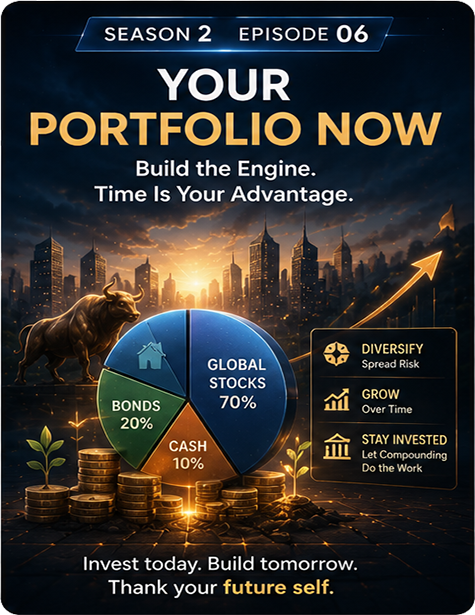
Episode Overview
Duration: 16:10 minutes
You have an emergency fund you can reach. You know what lands in your account and where it goes. You know which debt works for you and which works against you. The foundation is holding — so this episode builds the thing that sits on top of it. Something that runs whether you are paying attention to it or not. I want to be honest up front: this episode asks you to be more aggressive than you probably expect, and more careful than you probably expect, at the same time. Both are true. They just apply to different pots of money. This is also where your situation stops resembling anything Series 1 described, because you are not one parent funding one goal on one date — you have one income and several goals at different distances.
What You’ll Learn
- What ten years of waiting actually costs, using the same monthly amount run twice
- The three horizons — and why sorting money by when you need it comes before any decision about risk
- The mistake almost nobody warns you about, and why it is not being too aggressive
- Why your income is an undiversified asset, and how people accidentally bet salary and savings on the same outcome
- The four rules that keep the engine running once it is built
Key Takeaways
Sort your money by when you need it
Short, medium and long money have different jobs, so they carry different risk. Decide the horizon first and the risk second — not the other way round. The mistake nobody warns you about is not being too aggressive. It is being aggressive with money that has a deadline.
Your income is an asset, and it is concentrated
Your ability to earn sits in one industry, usually one country, often one economy. Point your investments at that same thing and you have not diversified — you have doubled down. The year the industry contracts is the year your income and your portfolio fall together.
Time only works if you leave it alone
A 30% fall is a catastrophe if you need the money in 18 months and a discount if you need it in 30 years. But that only holds for the person still holding at the bottom. The emergency fund’s real job is making sure you are never a forced seller.
Episode Summary (click to expand)
An overview of what’s covered in this episode.
The foundation is holding. The emergency fund is somewhere you can reach it, you know what actually lands in your account each month and where it goes, and you know which debt is working for you and which is quietly working against you. Now we build the engine — the point where your money stops being money and starts being a system that runs whether you are paying attention or not.
What Ten Years of Waiting Costs
Start with the asset nobody talks about as an asset: time. Right now you have more of it than you will ever have again. If you are somewhere between finishing your studies and starting a family, you are looking at three, four, maybe five decades before this money has a job to do. Series 1, episodes 2 and 3 cover the four forces underneath all of this — time, diversification, compounding and automation — so I will not rebuild them here. But I do want to show you what time does when you let it work.
Take 200 euros a month at 7% a year — a long-run average, not a promise. Start at 22 and stop at 62 and you will have paid in 96,000 of your own money, and you would be sitting on roughly 525,000. Now run it again starting ten years later. Same 200 a month, same 7%, still stopping at 62. You pay in 72,000 instead of 96,000, so 24,000 less out of your own pocket, and you end up with around 244,000. Ten years of waiting, 24,000 of contributions saved, roughly 281,000 gone. That is the whole argument — not discipline, not clever fund selection, not timing. Just the decades.
That is why, for money with decades in front of it, the right posture at your stage is growth. Not because you are brave, but because a 30-year holding period is what turns volatility from a risk into noise. A fall of 30% is a catastrophe if you need the money in 18 months. If you need it in 30 years, it is a discount. But time only reduces risk if you actually leave the money alone — that is a condition, not a guarantee. The person who sells in the middle of a crash has converted a temporary decline into a permanent loss, and no amount of time repairs that. So growth is the right call, but only once the emergency fund is built and the unproductive debt is cleared. No portfolio reliably returns more than a credit card charges you. Skip those two and you are not investing, you are gambling with a deadline.
Three Horizons: Not All Your Money Has the Same Job
Here is where your situation is genuinely different from anything Series 1 describes. There, a parent invested for a child — one goal, one date, and the parent’s own life funded from somewhere else entirely. You do not have that. You have one income, and everything you want has to come out of it. So you do not have one goal. You have several, at different distances.
Short, 0 to 3 years: the emergency fund, next year’s insurance, a course you have committed to. This money is not invested — not out of timidity, but because its job is to be there on a specific day, in full. Medium, 3 to 10 years: a deposit on a home, a career break, a move abroad, further study. This is the one people get wrong in both directions. It is too close to be fully exposed to the market, and too far to sit in cash losing to inflation for a decade. Long, 10 years and beyond: retirement, financial independence, the engine. This is where aggressive belongs and where it should stay.
The mistake almost nobody warns you about is not being too aggressive. It is being aggressive with money that has a deadline — putting a house deposit into a global equity fund a year before you need it. That is not ambition. It is handing a decision that matters enormously to something you cannot control. And the reverse mistake is just as expensive: leaving money with 40 years in front of it in a savings account because the market feels frightening. That is not caution. That is a slow, quiet, guaranteed loss to inflation, and you will not notice it happening.
Your Income Is an Asset — and It Is Not Diversified
In Series 1 the child portfolio was the whole picture. Yours is not. You have another asset, bigger than your portfolio will be for years: your income. Your ability to earn is an asset, and it is concentrated — in one industry, usually one country, often one economy. If you work for yourself you are more concentrated than anyone, not less, because your income and your work are the same bet.
So consider what happens when you point your investments at exactly the same thing. You work in technology and buy technology funds, because that is the industry you understand. You are given shares in your employer and hold them because selling feels disloyal. You run a construction business and invest in property, because property is the world you know. That is not diversification. That is doubling down. The year the industry contracts is the year your income falls and your portfolio falls together — precisely when you need it, and precisely when it is worth least. If you are given shares in the company you work for, treat them like anything else you own: worth holding only if you would buy them with cash today. Most people would not. Diversification is not only about spreading money across companies. It is about not betting your salary and your savings on the same outcome.
What the Long Money Actually Goes Into
I am not going to rebuild the technical episodes here — Series 1 episode 6 covered passive investing, episode 7 covered asset classes, episode 8 covered exchange traded funds. They were built for parents, but they were never only for parents. Still, you deserve a straight answer. For the long money, the pot with ten years or more in front of it, a single broad, global, low-cost index fund is a complete portfolio. Not a starting point you upgrade later. Complete. Thousands of companies, dozens of countries, one holding. What it is not is a collection of clever picks — not the stock a colleague is excited about, not the fund named after whatever performed best last year, because whatever performed best last year is exactly what is being sold to you hardest right now. It is boring on purpose. Boring is what makes it survivable, and surviving is what makes it work.
The Allocation You Have Already Built
You have heard portfolios described as a split — so much in shares, so much in bonds, so much in something else. Now go back and look at the three horizons. Cash in the short pot. Something steadier in the medium pot. Equities in the long pot. That is your allocation. You already built it. It just does not sit inside a single account, so it does not look like a portfolio. It looks like your life. Which is why someone at your stage holding a slice of bonds inside a 30-year pot is often solving a problem they have already solved somewhere else. The safety is in the short and medium money. It does not need to be inside the long money as well.
How to Start From Where You Are
If you have a lump sum — an inheritance, a settlement, savings built up while studying — the danger is treating it as an event rather than a foundation. Sequence matters: emergency fund first, unproductive debt second, and what remains goes to work. All at once or spread over months? Time in the market is what you are buying, so in one go is usually the stronger option — but if that means you freeze and do nothing for a year, spread it over 6 or 12 months instead. The plan you actually follow beats the plan that is theoretically better.
If you are living at home and working, you have the highest saving rate you will ever have, and it has an expiry date. The trap is that there is no urgency, so nothing gets decided. Fix a percentage of your income now, automate it, and let the amount rise as your income does. Do not save what is left at the end of the month — there is never anything left at the end of the month. And if you are starting from zero, start with an amount that feels almost embarrassingly small. Fifty euros. Twenty-five. The number is not the point; the system is the point, and a system that exists can be scaled. A perfect plan you start next year cannot. Set it to leave your account the day after you are paid, so it is gone before you have made a decision about it.
The Four Rules of the Engine
One: automate it — every step that requires you to remember is a step where it stops. Two: leave it alone — once a quarter is plenty, and checking daily does not improve returns, it only improves the odds that you interfere. Three: split every increase in income, half to your life and half to the engine, so you never feel the loss because you never had it. Four: never sell it to fund something you want — that is what the emergency fund and your monthly budget are for. The moment the engine becomes a source of spending money, it stops being an engine.
Time is doing most of the work here. Your job is smaller than you think: sort your money by when you need it, decide the shape once, automate it, protect it from yourself, and let the decades run. But I have left one question open, and it is probably the one you are still holding. How much goes into each pot? What does the medium-term money actually go into? And how much risk is too much when you have 30 years in front of you and nobody depending on you yet? Next episode we go inside the portfolio — real proportions, real risk levels, and the honest answer on when any of it should start to change.