Episode 12 — The Platform
Duration: 14:35 minutes
The engine needs a home. This episode gives you the criteria to choose the right one.
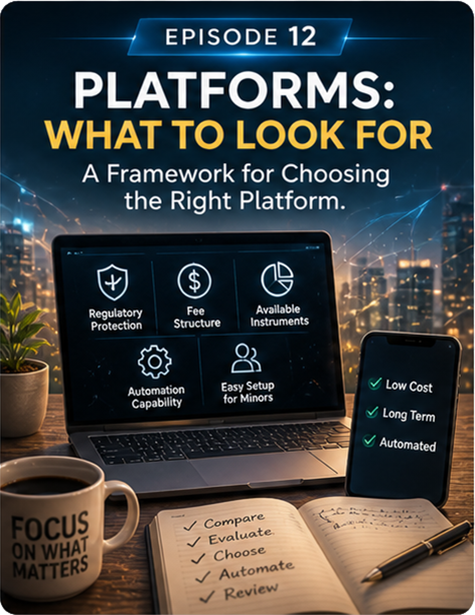
Episode Overview
Duration: 14:35 minutes
The engine is designed. Now it needs a home. In this episode, I walk through the framework for choosing the right investment platform — the account where the ETFs live, where the monthly contributions land, and where the system runs for the next two decades. I cover the regulatory frameworks that protect your assets across the EU, Switzerland, the UK and the US, the five types of platform and which best fits a passive long-term strategy, and the fee components most parents overlook when comparing options. I also share what I personally use — not as a recommendation, but as an example of how the framework plays out in practice.
What You'll Learn
- Why platform choice is not an administrative detail — it shapes your returns for the next 20 years
- The regulatory frameworks protecting your assets in the EU, Switzerland, the UK and the US
- The five types of platform and which fits a deliberate low-cost passive strategy
- Every fee component to calculate before deciding — beyond the headline commission
- How to evaluate automation and currency handling so the engine runs without monthly decisions
- A five-step decision process you can apply to any platform, anywhere
Key Takeaways
Verify the regulator first
Before anything else, search the platform on your country's official financial regulator register. If it is not there, do not proceed.
Calculate total cost of ownership
Transaction commissions are just the start. Custody fees, inactivity fees and currency conversion costs compound silently over 20 years — compare all of them.
Automation makes the engine self-driving
Not every platform supports automatic recurring investments. Confirm this before committing — it is the feature that removes the monthly decision from the system.
Episode Summary (click to expand)
An overview of what’s covered in this episode.
Choosing a platform feels like a small administrative step. It is not. The platform determines what instruments you can access, the fee structure that will quietly compound against or in favour of your returns for the next 20 years, and the regulatory protections covering your assets if something goes wrong. A good platform makes the system almost invisible. A bad one creates friction at every step — and friction is the enemy of consistency.
Know Who Is Protecting You
The most important question you can ask about any platform is who regulates it and what happens to your money if it fails. In Europe, any platform operating legally must be authorised under MiFID 2 and supervised by a national authority such as the AFM, BaFin, or the Central Bank of Ireland. EU investors benefit from national investor compensation schemes, and securities are held in segregated accounts — separate from the broker’s own assets. In Switzerland, platforms must be authorised under FINMA. In the UK, the FCA and the FSCS protect investment accounts. In the US, brokers must be registered with the SEC and FINRA, with SIPC protection up to half a million dollars.
The Five Types of Platform
I walk through five platform types: full-service brokers (high cost, personal advice, suited to complex situations), discount online brokers (low to medium cost, direct market access, best fit for a deliberate passive strategy), robo-advisors (automated portfolio management, medium cost, genuine discipline with minimal effort), neobrokers (commission-free, mobile-first, very low cost, worth understanding the business model before committing), and banks with brokerage (convenient but typically the most expensive, narrowest range, sometimes conflicted). In most cases, the bank option will not hold up to a thorough fee comparison.
The Criteria That Matter
Regardless of platform type, I cover the criteria every parent needs to evaluate: regulation and investor protection (non-negotiable), fee structure across all its forms — transaction commissions, custody fees, inactivity fees, and currency conversion costs — automation capability for recurring monthly investments, and currency handling if you plan to invest in funds denominated in a different currency than your account. I bring it together into a five-step decision process: verify the regulator, calculate total annual cost across at least two or three options, confirm the instruments you need are available, confirm automation support, and check currency handling.
Listen to the full episode to hear the complete framework, the platform comparisons, and what I personally use — shared not as a recommendation, but as a concrete example of how this framework plays out in practice.