Bonus Episode 3 — The Mortgage, Part 2: Choosing the Rate
Duration: 15:26 minutes
Everyone frames fixed versus variable as a prediction about where rates are going. It is not a prediction — and the question that actually decides it is about your budget, not the market.
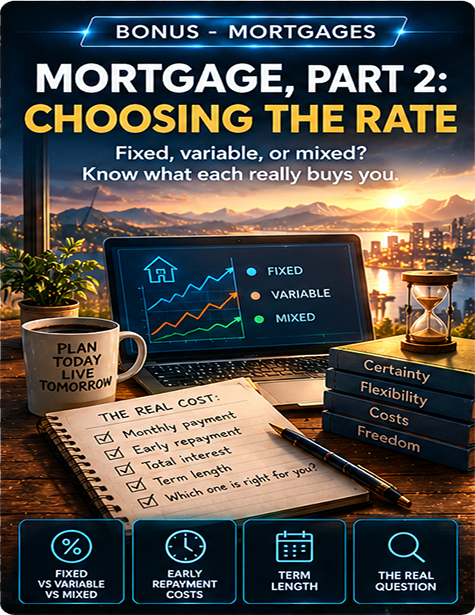
Episode Overview
Duration: 15:26 minutes
Two hundred thousand borrowed over thirty years with a one percent spread. At the end of 2021 that payment is about 598 a month. Two years later — same loan, same spread, same house, same person — it is about 1,074. Nothing about that borrower changed. In Part 1 we chose the bank; here we choose the rate, and that number is the reason the choice matters. Most people treat fixed versus variable as a prediction about where rates are going. It is not a prediction, and this episode shows you what the question actually is — along with why fixed is never simply the safe option, and why two completely different products both get called “fixed” in conversation.
What You’ll Learn
- What actually moves your reference rate, and how often yours resets
- Variable, fixed and mixed — what each one buys you and what each one costs you
- Why fixed is not simply safer, and the two products that share the name
- The one question that decides it, which is about your budget and not the market
- What repaying early costs, and what stretching the term really costs you
Key Takeaways
It is not a forecast, it is a budget question
Not where do I think rates are going — you do not know, and the professionals are wrong regularly with far better information. The question is whether your budget would absorb a payment rising by 400 a month, or break. That is the whole decision.
Fixed is a purchase, not a safety setting
A fixed rate is priced above the current variable rate, and it usually carries far higher penalties to repay early or move banks. The certainty costs you twice — once in the rate, again in the flexibility. Sometimes worth every cent, but never free.
Two different products are both called fixed
In some countries fixed runs the whole loan; in others it means two, five or ten years, after which it turns variable or you renegotiate at whatever the market looks like that day. Ask directly which one you are being offered, and what happens on the day it ends.
Episode Summary (click to expand)
An overview of what’s covered in this episode.
Let us start with a real number. Two hundred thousand borrowed, over thirty years, with a one percent spread. At the end of 2021 the payment on that loan is about 598 a month. Two years later — the same loan, the same spread, the same house, the same person — the payment is about 1,074. Nothing about that borrower changed. They did not move, did not borrow more, did not miss anything in the small print. Their payment went up by roughly 475 a month, close to 5,700 a year, out of an income that had not grown anything like as fast. In the previous episode we chose the bank. Today we choose the rate, and that number is the reason the choice matters.
What Actually Moves Your Rate
In Part 1 I said your interest rate is two numbers added together: a reference rate nobody in the branch controls, and the bank’s margin on top. If half your interest cost is a rate the bank cannot change, it is worth knowing what does change it. Two things, mainly. First and biggest, the central banks — the European Central Bank for the Eurozone, the Swiss National Bank for Switzerland, the Federal Reserve for the US. They set a policy rate and market rates follow it closely. Second, what the central bank is reacting to, which is mostly inflation. When inflation runs hot, central banks raise rates to slow borrowing and spending. When the economy weakens, they cut to encourage it. So your mortgage payment is downstream of the inflation rate in your currency zone — a connection almost nobody makes until it turns up in their bank statement.
That is exactly what happened in the numbers I opened with. In December 2021 the main euro interbank rate was below zero, and had been negative for around seven years — long enough that a whole generation of borrowers had never known anything else and had quietly come to assume it was normal. Then inflation arrived. The European Central Bank raised rates faster than at any point in the euro’s history, and in under two years the same reference rate went from below zero to above 4%. That is what a variable rate means in practice: not a percentage on a page, but a payment that nearly doubles while you are doing nothing wrong. Rates have come down again since, which is the other half of the point. It moves both ways, and the fall is just as real as the rise. But you have to be able to survive the direction you did not want.
One more piece, and this one is purely practical. Your rate does not follow the market continuously — it resets on a schedule, and you should know yours. In the Eurozone, mortgages are typically indexed to Euribor at three, six or twelve months. That is your reset period. A three-month contract reprices four times a year. A twelve-month contract reprices once, so it takes a full year to feel a rise — and a full year to feel a fall. In Switzerland the money market rate used is a compounded average over three months, so it updates quarterly. In the US, adjustable loans commonly reset every six or twelve months once the initial period ends. None of this is better in the abstract, but they behave very differently in a year when rates move fast, and you should know which one you signed.
Variable, Fixed and Mixed
Variable: your rate follows the reference rate. When the market rate rises, your payment rises; when it falls, your payment falls. You are paying whatever borrowing costs at that moment, plus your margin. Fixed: your interest rate is locked, and your payment does not move regardless of what happens in the market. Mixed: fixed for an initial period, variable afterwards — you buy certainty for the years when you most need it, the early ones, when you have just emptied your savings into a deposit and furniture, and accept movement later, when your income has probably grown.
The part that gets skipped is that fixed is not simply the safe option. It comes with three consequences. First, you pay for the certainty — not normally, always. A fixed rate is priced above the current variable rate because the bank is taking the risk of rates rising instead of you. That premium is the price of a predictable payment. Sometimes it is worth every cent, but it is never free. Second, fixed rates typically carry much higher penalties if you want to repay early or move to another bank. In one European country the legal maximum early repayment fee is half a percent of the capital repaid on a variable rate loan, and 2% on a fixed rate — four times as much. Elsewhere, breaking a fixed rate mortgage can cost considerably more, because the bank charges you for the interest it expected to receive and no longer will. So the certainty costs you twice: once in the rate, and again in the flexibility.
Third, check what fixed actually means where you are, because the word covers two different products. In some countries a fixed rate genuinely runs the whole loan — sign a 30-year fixed and you are paying the same rate in year 29 as in year one. Portugal offers this; so does the US. In others, fixed means fixed for a period, commonly 2, 5 or 10 years, after which it turns variable or you renegotiate at whatever the market looks like on that day. Those are not small print variations. They are different products with different risks, and both get called fixed in conversation. So ask directly: is this rate fixed for the whole term, or for a period? And if it is a period, what happens on the day it ends? Full-term certainty is the expensive one. On a loan of 180,000 over 30 years, a full-term fixed rate priced just over a percentage point above a mixed rate costs well over a hundred euros a month, every month, for the privilege of never having to think about it again. Sometimes that is money well spent — but you should know you are spending it.
The Question That Actually Decides It
Not: where do I think rates are going? You do not know. I do not know. The people who do this professionally are wrong regularly, and they have far better information than either of us. The question is this — if your payment rose by 400 a month, would your budget absorb it, or would it break? If it would absorb it, variable is a reasonable choice, and you keep the flexibility and the lower early repayment penalties that usually come with it. If it would break you, you buy certainty and you accept that certainty has a price. That is the whole decision. It is a question about your situation, not about the market.
Be honest with yourself about which one you are. If you are early in your career, your income will probably rise over the next decade, and that is a real argument for being able to carry some movement. But if you are stretching to afford the property in the first place — and a great many first purchases are a stretch — then you have no room to absorb anything, and the certainty is worth paying for. Those two situations feel similar when you are excited about a house. They are not.
Repaying Early, and What the Term Costs
Paying down early varies enormously by country, and it is worth asking before you sign rather than after. In some places you can repay capital whenever you like at no cost, and your interest recalculates immediately. In others there is a penalty and it is meaningful. Two things to check. First, whether the fee applies at all and how much — and watch out for old information here, because these rules change, sometimes temporarily. One European country waived the fee on variable rate loans for three years and then let the waiver expire. Check what is true today, not what was true when you last looked. Second, and this one is missed constantly: when you do repay early you usually face a choice — reduce the monthly payment, or shorten the term. Shortening the term saves far more interest. Reducing the payment gives you breathing room now. Neither is wrong, but they are very different outcomes, and banks often default to one without asking which you wanted. One rule is not negotiable: never use your emergency fund to repay a mortgage early. You are converting money that is available into money that is locked inside a wall.
The duration of the mortgage is the variable people treat as an afterthought, and it changes the total more than almost anything else. Round numbers: borrow 100,000 at a total cost of 3% a year. Over 20 years your payment is about 555 a month and you repay about 133,000 in total — 33,000 of that is cost. Stretch the same loan to 30 years and the payment drops to about 422. That is 133 a month easier, a real relief, and for some households the difference between affordable and not. But you repay about 152,000, and the cost goes from 33,000 to nearly 52,000. You bought that monthly relief for around 19,000. That is not an argument against long mortgages — sometimes the shorter term is simply unaffordable, and an unaffordable mortgage is not a clever mortgage, it is a repossession waiting for a bad year. It is an argument for knowing the price of the choice rather than discovering it two decades later.
Not Every System Expects You to Repay
One last thing, because it surprises people who move countries. Not every system assumes you repay the loan in full. In some countries the mortgage is divided into two parts: roughly one third of the property’s value must be cleared, usually within 15 years or by retirement, and everything below that has no maturity date and never has to be repaid at all. Many people carry it for life and pass the property on with the debt still attached. But the debt having no maturity does not mean the contract does. Your rate agreement still runs on a term, and when it ends you renegotiate, renew or move — and the bank reassesses you each time, which makes retirement a risky renewal, because the same loan gets tested against a much smaller income. So if you hear someone say their mortgage renews every few years, they are not talking about the loan. They are talking about the contract. I am not holding this up as better or worse. I am saying that how a mortgage works is not one thing, and a system that rewards carrying debt produces very different habits from one that rewards clearing it. Check your assumptions at the border.
So, choosing the rate. Know what moves your reference rate, and how often yours resets. Understand that fixed is not simply safer — it is a purchase, with a price and a penalty attached. Ask the budget question honestly, not the forecast question. Find out what it costs to repay early and which choice you get when you do. And know what the term is really costing you. Two episodes, two decisions: choose the bank on total cost with at least three offers on the table, and choose the rate on whether your budget can absorb movement. Everything else is detail — and now you know enough to ask about the detail properly.