Bonus Episode 2 — The Mortgage, Part 1: Choosing the Bank
Duration: 17:26 minutes
The rate you were quoted is not what you pay. The anatomy of a mortgage, the half of it that is genuinely negotiable, and the one number worth comparing between two offers.
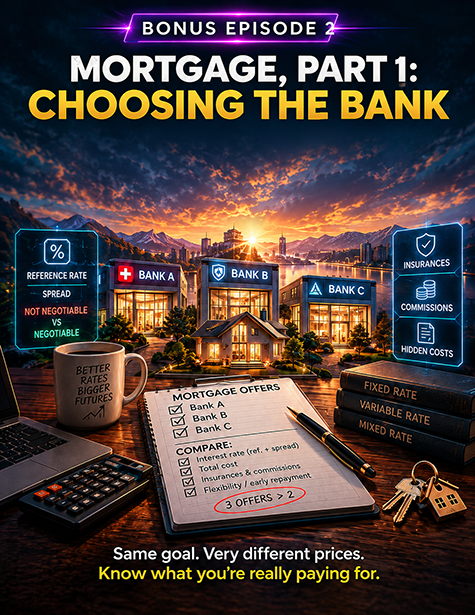
Episode Overview
Duration: 17:26 minutes
In Episode 5 I said a mortgage is, in principle, the clearest example of productive debt — and that in practice a handful of variables decide whether it actually is. This is the first of two bonus episodes on that detail. Most financial decisions you make in your twenties are reversible: the wrong savings account gets moved, the wrong fund gets switched, and the cost of being wrong is small. A mortgage is not like that. It is the longest financial commitment most people ever make, which is why it is worth understanding properly once, before you sign, rather than afterwards. This part is about choosing the bank — what you are actually paying, and how to compare one lender against another. Part 2 is about choosing the rate.
What You’ll Learn
- Why the rate you were quoted is two numbers added together, not one
- Which half the bank controls, which half is negotiable, and why almost nobody tries
- The insurances and commissions that never appear in the headline rate
- Why the same borrower gets very different prices from different lenders
- The one figure worth comparing between offers — and why three offers beat two
Key Takeaways
The rate is two numbers, not one
A reference rate the bank neither sets nor controls, plus a margin that prices you specifically. One moves with the world. The other was decided in a conversation you could have negotiated harder. Almost nobody separates them, and that is where the money is.
The headline rate is not what you pay
Mandatory insurances, arrangement and valuation fees, and premiums that climb every year with your age all sit outside the advertised number. Ask what can change, who gets to change it, and when — because you do not get a vote later.
Get three offers, and compare the right number
Two offers tell you which of two banks is cheaper. Three start to tell you what the market looks like. Ask each the same question — not the rate, but the total annual cost including everything you are obliged to buy.
Episode Summary (click to expand)
An overview of what’s covered in this episode.
In Episode 5 I said a mortgage is in principle the clearest example of productive debt, and that in practice a handful of variables decide whether it actually is. I said the detail was coming in a bonus episode. It turned out to be more than one — this is the first. Before anything else, I want to explain why I am giving this so much room.
Why This One Is Different
Most financial decisions you make in your twenties are reversible. Choose the wrong savings account and you move it. Pick a fund you later decide against and you switch. The cost of being wrong is small and the correction is quick. A mortgage is not like that. It is the longest financial commitment most people ever make, and exactly how long depends entirely on where you are: some countries allow terms stretching 40 years or more, others structure them far shorter, and in some systems the loan is never expected to be fully repaid at all — people carry part of it for life, by design. Because it runs that long, small differences stop being small. A quarter of a percentage point sounds like nothing. Across decades, on a sum that size, it is not nothing. Half a point in the wrong direction on a large mortgage can cost more than a car.
Is it reversible? Partially — and this is worth knowing before you terrify yourself into paralysis. In a good number of countries you are not locked in for life. You can go back to your own bank and renegotiate, particularly if your income has improved, if you have repaid a meaningful chunk, or if a competitor is offering better and you are willing to say so. In some markets you can move the entire mortgage to a different bank. It is not free — expect fees, fresh valuations, paperwork, sometimes an early repayment charge — but where the gap is large enough it pays for itself. Whether that is available to you, and what it costs, varies enormously. Find out early, because it changes how much pressure sits on the original decision. If your country lets you move a mortgage reasonably cheaply, a mediocre starting deal is a temporary problem. If it does not, the deal you sign is the deal you live with.
The Anatomy Is Universal
Mortgages are not one product. They differ widely country to country: how much you can borrow, how long for, whether you ever have to repay in full, what you are forced to insure, what it costs to pay back early. All of it changes at the border. Advice written for someone in the US can be actively wrong for someone in Portugal, and advice written for Portugal can be wrong in Switzerland. I cannot cover every system. But the anatomy is universal — every mortgage in every country is built from the same handful of components, and only the names and local rules change. Learn the anatomy and you can walk into a bank in a country you have never lived in, ask a few questions, and understand what you are being offered.
The Rate Is Two Numbers
Almost everyone shopping for a mortgage compares one number: the rate they were offered. They put it next to what a friend was offered, pick the lower one, and believe they have optimised the largest financial commitment of their life. But the rate is not one number. It is two added together — a reference rate, and the bank’s margin on top of it.
The reference rate is a market rate. Your bank does not set it and cannot change it. In the Eurozone it is Euribor, in Switzerland it is SARON, and in the United States adjustable loans typically use SOFR. Different names, same function: a published rate reflecting what banks pay to borrow money themselves. That is the part nobody in the room controls — not you, and not the person sitting opposite you. The margin is the bank’s price for lending to you specifically. In Portugal it is called the spread; in Switzerland and the US, the margin. Different words, identical thing. That split matters enormously, because the two halves behave completely differently. One moves with the world. The other was decided in a conversation you could have negotiated harder.
The Half You Can Influence
The spread is what the bank charges above the reference rate. It is their profit and their pricing of you as a risk, which means it is not the same for everyone and it is not fixed by the market. It reflects how much you are borrowing against the property’s value, how stable your income looks, whether you are employed or self-employed, and how much the bank wants your business that month. It is negotiable. Most people do not negotiate it. And it varies more between lenders than people expect, even in markets everyone describes as simple and transparent — in one such market, a comparison service found lender margins on the same product ranging from 0.65% to roughly 1.16%. Half a percentage point of pure difference, decided by nothing more than which door you happened to walk through. One more thing that catches people: in some countries the spread is fixed for the life of the loan, in others only for a framework term, after which the lender can revise it. You agreed a margin once. Check whether you agreed it forever.
The Costs That Are Not in the Rate
Your mortgage will oblige you to buy things. Life insurance, in most countries covering the outstanding debt, so that if you die the loan dies with you and your family keeps the home. Buildings insurance, without which in many places you simply will not be given a mortgage. Beyond those two it depends entirely where you are, including for risks you would never think to ask about. There are countries where the bank requires seismic cover on any mortgaged property, and where adding it noticeably increases what you pay each year — and neighbouring countries where the same cover is not required at all. Same continent, opposite rule. Whatever you learn about mortgages somewhere else, check it at the border.
Two things about these insurances that almost nobody tells you. First, the bank will usually offer a lower spread if you take its own policy. That is legal and it is a real discount — but bank insurance is frequently among the most expensive on the market, sometimes several times the price of an equivalent policy elsewhere. In many countries you have a legal right to use any authorised insurer provided the cover meets the bank’s minimum. What the bank can legally do, and it will be written into your contract, is withdraw the discount that was conditional on taking its product. Find out whether that right exists where you are. It is one of the most valuable things on this list and one of the least known. The question is arithmetic: is the annual saving on the premium larger than the annual cost of losing the discount? Often it is. But you have to actually run the numbers, and almost nobody does.
Second, these costs do not stay still and you do not get a vote. Your life insurance premium is typically recalculated every year on two variables: your age and the capital still outstanding. You get one year older every year, so the premium climbs automatically — no renegotiation, no letter asking your opinion. In the early years the rising age effect can outrun the falling debt effect entirely. So do not take today’s number and assume it holds for 25 years. Ask what can change, who gets to change it, and when. Then there are the commissions — arrangement fees, processing fees, property valuation, documentation fees. Some countries regulate this tightly, others do not, and banks are very inventive. In some markets this alone can add a meaningful slice of a percentage point to what you actually pay.
The One Number Worth Comparing
If the headline rate is misleading, what can you compare? Find out whether your country requires lenders to publish a total cost figure — a single percentage folding in the interest, the spread, the commissions, the mandatory insurance and the taxes. The real cost of the loan, not the advertised one. Many countries do require it, it goes by different names in different places, and in some markets it is not published at all. But where it exists, it is the only number worth comparing between two offers — and it is usually sitting in the paperwork nobody reads. Some countries also oblige the lender to give you a standardised information sheet before you sign, laying out the real terms in a fixed format so competing offers can be compared like for like. Ask whether you are entitled to one, and if you are, read the sections on early repayment and on what can change over time. Two offers can advertise the same headline rate and have meaningfully different total costs. That gap is where a great deal of money is made, and it stays invisible if the only question you ever asked was about the rate. So ask a different one. Not “what rate can you give me?” but “what is the total annual cost, including everything I am obliged to buy?”
Three Offers, and One Sentence
If you take nothing else from this episode, take this: get at least three offers. Not two. Three. Two offers tell you which of the two banks is cheaper. Three start to tell you what the market actually looks like, and whether the one you liked is genuinely competitive or just the first door you walked through. Ask each of them the same question — not their rate, but their total cost including everything you are obliged to buy. Then you are comparing like for like, which is the only comparison worth making.
And then the part people find uncomfortable, which is the part that pays: tell them you are comparing. The spread is negotiable, and most people hear that, agree with it, and never do it. A bank that knows it is in a race on price acts differently from a bank that assumes it has already won. That is not a trick and it is not rude — it is how the market is designed to work, and it is the only lever where a single conversation can be worth thousands over the life of the loan. You do not need to be aggressive. You need one sentence: this is what another lender has offered me, can you do better? Some will say no. Some will not.
So: what the reference rate is. What margin they are charging you, and that it is negotiable. What you are obliged to insure, whether you must buy it from the lender, and what happens to that price as you age. What the commissions are. What the total cost figure says rather than the headline. Whether you can renegotiate or move the loan later. And three offers compared on the same question. That is the anatomy, and it works in any country — only the answers change. In Part 2 we choose the rate. I will show you what actually happened to one ordinary mortgage payment in the space of two years, and then take the decision everyone frames as a gamble and show that it is not one. Fixed, variable and mixed — what each one buys you, what each one costs you, and the question that decides it, which I promise you is not a question about where interest rates are going.